Introduction
A few years ago, a college assignment usually meant a Google search, a few textbooks and perhaps a late-night discussion with friends.
Today, a student can ask an AI tool to explain a difficult concept, summarise a chapter, generate code or even help prepare for an interview in seconds.
That change raises an important question for students: if AI can do so much already, what should universities teach us now?
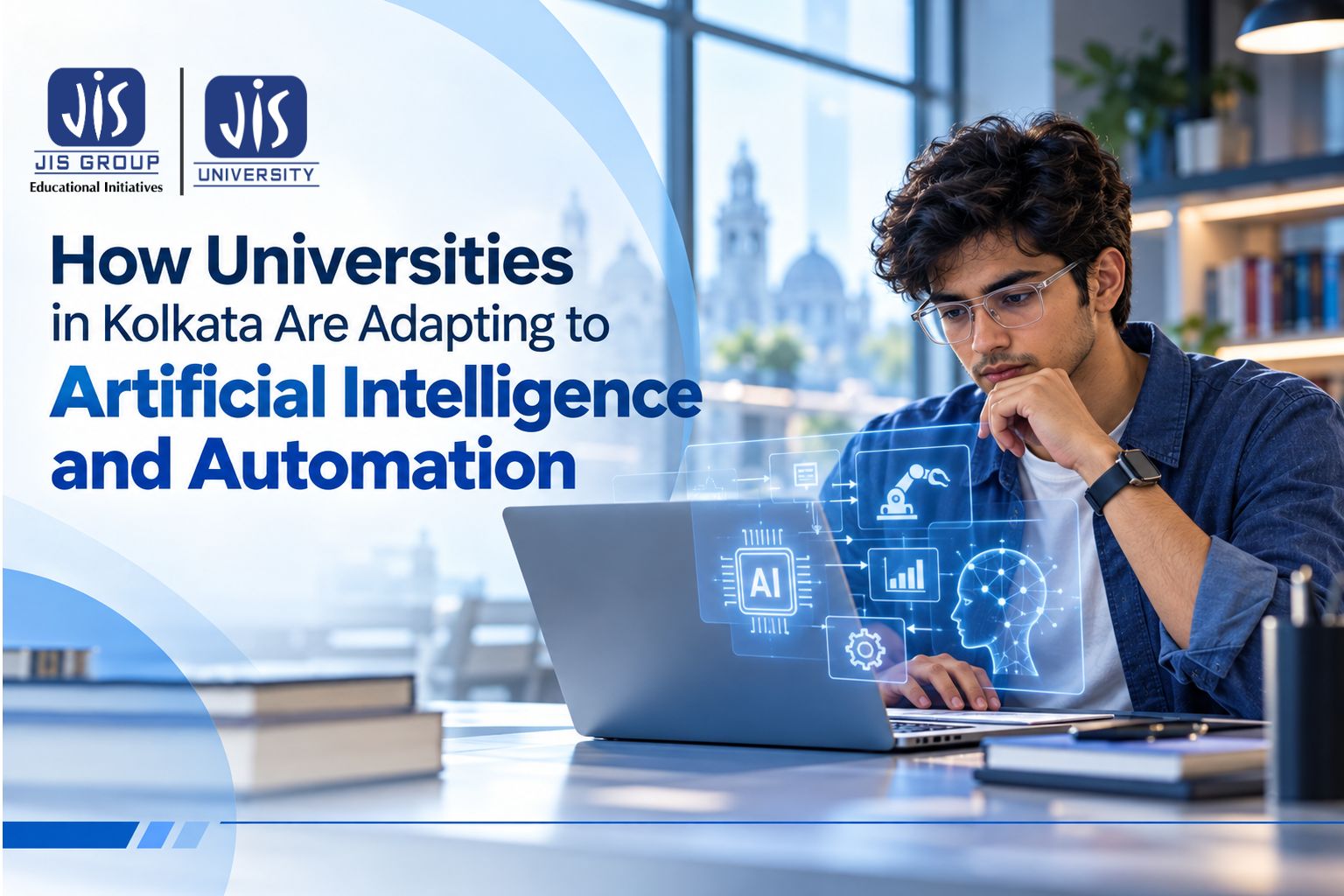
This is where AI in higher education in Kolkata is becoming increasingly relevant. Universities and higher education institutions are exploring how artificial intelligence can support teaching, learning, research, student services and career preparation.
But this doesn't mean that AI is simply replacing teachers or turning classrooms into fully automated spaces. The bigger shift is about helping students learn how to work with AI responsibly while developing the human and technical abilities AI cannot replace easily.
Why Is AI Becoming Important in Higher Education?
Think about a student learning programming.
Earlier, if you got stuck on a coding problem at 11 PM, your options were usually to search online, check your textbook or wait until the next class.
Now, an AI assistant can explain the error, suggest an approach and even walk you through the logic.
That's convenient but there's a catch.
If the student simply copies the AI-generated answer, the technology has solved the immediate problem without necessarily improving the student's understanding.
This is why universities need to focus not just on using AI, but on teaching students how to question, verify and apply AI-generated information.
Research and industry analysis increasingly point towards this shift. A 2025 FICCI-EY-P survey of 30 Indian higher education institutions found that many institutions were already developing AI policies, while reported academic uses included generative AI for teaching materials, tutoring, adaptive learning and automated assessment.
What Does AI Adoption in Universities Actually Mean?
When people hear AI adoption in universities, they may imagine robots walking around classrooms.
The reality is much more practical.
AI can be introduced into higher education in several ways.
Personalised Learning
Imagine two students attending the same mathematics class.
One understands calculus quickly. The other needs more practice.
An AI-enabled learning platform can potentially provide additional exercises or explanations based on individual learning needs.
This kind of personalised support can make learning more flexible.
AI-Assisted Teaching
Teachers can use AI tools to create learning materials, generate practice questions, organise information or develop different explanations of difficult concepts.
That doesn't remove the role of the teacher.
Instead, it can reduce some repetitive work and give educators more time to focus on discussion, mentoring and student interaction.
Smarter Student Support
AI can also be used for frequently asked questions, academic assistance and administrative support.
For example, instead of waiting for office hours to ask something as simple as “When is the last date to submit this form?”, students may be able to get routine information through digital support systems.
The goal is convenience not replacing human support when a student has a complex problem.
AI Education in Kolkata Is Also Changing What Students Learn
There is another important change happening.
Universities are not only using AI to teach. They are increasingly expected to help students learn about AI.
This distinction matters.
A mechanical engineering student may not become an AI specialist, but understanding data, automation and AI-enabled systems could still be useful in manufacturing.
A management student may encounter AI-powered analytics, customer insights or automated business processes.
A computer science student may explore machine learning, generative AI or data science in much greater depth.
UGC's institutional development guidance specifically identifies technologies such as AI, machine learning, data analytics, IoT, robotics and cybersecurity as areas that higher education curricula should consider as part of skill development and the changing nature of work.
AI-Enabled Education in Kolkata: What Could the Student Experience Look Like?
Let's make this more relatable.
Suppose you are a first-year engineering student struggling with a programming concept.
Instead of simply reading the same explanation repeatedly, you could use an AI tool to ask:
“Explain this concept like I'm a beginner.”
Then you could ask for an example, try writing the code yourself and use AI to identify where your logic went wrong.
The important part is you still do the thinking.
A good university always encourages students to use AI as a learning assistant rather than an answer machine.
This is where digital literacy becomes important.
Students need to know:
-
How to write useful prompts
-
How to check AI-generated information
-
How to identify errors or hallucinations
-
How to protect personal and academic data
-
When AI should and should not be used
-
How to acknowledge AI assistance appropriately
These are becoming valuable AI skills alongside traditional subject knowledge.
Universities Are Rethinking the Skills Students Need
Imagine two graduates applying for the same job.
Both have similar academic qualifications.
One knows only the technical concepts covered in the syllabus.
The other understands those concepts but can also use AI tools, analyse information, communicate ideas clearly, solve unfamiliar problems and work effectively with a team.
The second student's advantage isn't simply “knowing AI.”
It is knowing how to combine technology with human judgement.
This is why future-ready skills are becoming an important part of higher education.
Students may need a combination of:
-
Technical knowledge
-
AI literacy
-
Problem-solving
-
Communication
-
Critical thinking
-
Creativity
-
Adaptability
-
Teamwork
-
Data literacy
The Ministry of Education has also highlighted AI's potential to support teaching, learning, assessment and workforce development, with a proposed Centre of Excellence in AI for Education focused on areas including machine learning, robotics, data science and AI ethics.
What About Campus Placement?
For students, all of this eventually leads to one practical question:
“Will these skills help me get a job?”
The answer depends on how well students actually develop and demonstrate those skills.
AI is changing job roles across industries, which means employers may increasingly value graduates who can work with technology rather than simply understand it theoretically.
That's why universities are paying greater attention to internships, industry interaction, projects and practical learning.
AI skills can become particularly useful when combined with real project experience.
For example, instead of writing “I know AI” on a CV, a student could demonstrate:
-
A machine-learning project
-
An AI-powered application
-
A data-analysis project
-
An automation solution
-
A research project involving AI
-
An internship where AI tools were used responsibly
That gives employers something concrete to evaluate.
AICTE's National Internship Portal also provides a government-supported platform connecting students with internship opportunities across government bodies, PSUs, institutions and private organisations.
AI Doesn't Make Human Skills Less Important
This is probably the most important point for students.
AI can generate an email.
It can write code.
It can summarise a report.
It can analyse data.
But what happens when a team disagrees about a product decision? Or when a customer has a problem that doesn't fit neatly into a dataset?
That's where communication, empathy, judgement and critical thinking matter.
So, if you're entering university now, don't think:
“I need to learn AI instead of everything else.”
Think:
“I need to understand AI while becoming better at the things that technology cannot easily replace.”
That is a much more useful approach.
AI Adoption Also Requires Responsible Use
More technology means more responsibility.
Universities need to think about academic integrity, privacy, bias, transparency and appropriate use of AI in assessments.
For students, this means understanding that an AI-generated answer isn't automatically a correct answer.
For example, an AI tool might confidently provide an incorrect technical explanation or an outdated statistic. If you submit it without checking, the responsibility still falls on you.
That's why AI literacy should include verification, not just usage.
UGC's current framework includes guidelines around academic integrity, research quality and student-focused higher education, while its 2025 guidelines also include internships and university-industry linkages.
Technology Is Only One Part of a Good University
When choosing a university in Kolkata, don't look at AI facilities alone.
Also consider:
-
Faculty expertise
-
Curriculum
-
Laboratories
-
Industry exposure
-
Research opportunities
-
Internships
-
Campus placement support
-
Student clubs and technical activities
-
Infrastructure
-
Student safety and support systems
For example, anti ragging initiatives remain an important part of a safe campus environment. AICTE regulations require approved technical institutions to maintain anti-ragging mechanisms, including committees, squads, cells, awareness activities and student support measures.
A future-ready campus isn't only one with advanced technology. It should also provide an environment where students can learn, experiment and participate without feeling unsafe or unsupported.
Affordability Matters Too
Technology-rich education should also remain accessible.
For students and families planning higher education in West Bengal, financial support can be an important part of the decision.
The Student Credit Card Scheme is included in West Bengal's State Education Policy as one of the schemes supporting students at the higher education level, particularly in the context of financial support for students from weaker sections.
Students should always check the latest eligibility conditions, participating institutions and terms through official government sources before making financial decisions.
What Should Students Do Now?
You don't need to become an AI expert before entering university.
Start with the basics.
Learn how AI works at a broad level. Experiment with reputable tools. Practise verifying information. Build small projects. Improve your communication and problem-solving abilities.
And don't abandon the fundamentals.
If you're studying engineering, understand mathematics and programming.
If you're studying management, understand business fundamentals and data.
If you're studying science, develop strong analytical and research skills.
AI becomes much more useful when it is built on top of solid subject knowledge.
Final Thoughts
The growth of AI in higher education in Kolkata is not simply about putting artificial intelligence into classrooms.
It is about preparing students for a world where AI will increasingly become part of how people study, research and work.
Universities are exploring AI-enabled teaching, digital learning, emerging technology courses, research and industry-linked opportunities. At the same time, students need to develop the judgement to use these technologies responsibly.
The real advantage will not necessarily go to the student who uses the most AI.
It may go to the student who knows when to use it, how to question it and how to combine it with strong human skills.
That is what being future-ready could increasingly mean.
Frequently Asked Questions
1. What is AI in higher education in Kolkata?
AI in higher education in Kolkata refers to the use of artificial intelligence in teaching, learning, assessment, research, student services and other university activities, along with education that helps students understand and use AI.
2. How are universities adopting AI?
Universities can adopt AI through personalised learning platforms, AI-assisted teaching, digital student support, research applications, AI-focused courses, data analytics and industry-linked projects.
3. Why are AI skills important for students?
AI skills can help students work more effectively with emerging technologies. However, AI knowledge should be combined with critical thinking, communication, problem-solving and strong subject fundamentals.
4. Will AI replace teachers in universities?
AI can support teachers with tasks such as creating learning materials, providing routine assistance and analysing learning data. Teaching also involves mentoring, judgement, discussion and human interaction, so AI adoption does not necessarily mean replacing educators.
5. How can students develop future-ready skills?
Students can develop future-ready skills through internships, projects, technical competitions, research, industry interaction, AI tools, communication practice and continuous learning.
6. Does AI affect campus placement opportunities?
AI is changing job roles and the skills employers look for across industries. Students can strengthen their profiles by combining subject knowledge with practical projects, AI skills, internships and problem-solving abilities.
7. How can students use AI responsibly for academic work?
Students should verify AI-generated information, follow their institution's academic-integrity rules, avoid submitting generated work as their own when prohibited, and protect confidential or personal information.
8. What other factors should students consider when choosing a university?
Along with AI facilities, consider curriculum quality, faculty, laboratories, research opportunities, internships, campus placement, industry exposure, affordability, infrastructure and student safety measures.