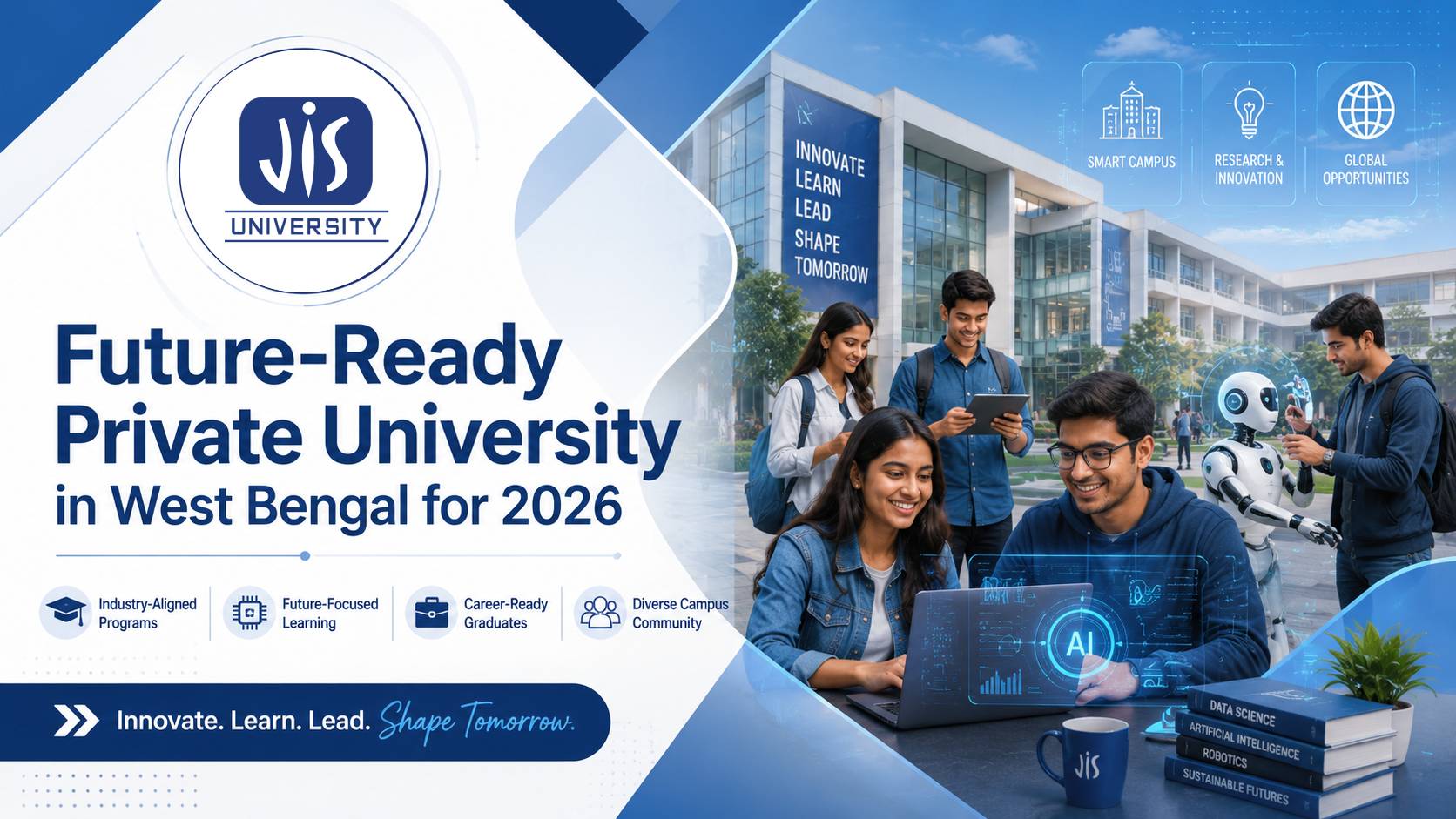
You're scrolling through social media and suddenly see two classmates sharing updates. One posts about building an AI-powered project with an industry mentor, while another shares a virtual internship experience with a leading company. At the same time, you start wondering: Will the university I choose today prepare me for opportunities that may not even exist yet?
That question is becoming important for thousands of students and parents. In today's rapidly changing world, education is no longer just about attending lectures and earning a degree. Students want skills, real-world exposure, practical learning, and confidence to succeed in future careers. That is why choosing a future-ready private university in West Bengal has become a major decision for students planning their academic journey in 2026.
As technology transforms industries and employer expectations continue to evolve, universities must move beyond traditional teaching methods and create learning environments that prepare students for tomorrow's challenges.
So what exactly makes a university future-ready? Let's explore.
Why Higher Education in West Bengal Is Rapidly Evolving
The landscape of higher education in West Bengal is changing due to technology, global employment trends, and increasing competition.
Recent education reports suggest that:
-
Technology-based learning is increasing across institutions
-
Employers prioritize practical skills over theoretical knowledge
-
Artificial Intelligence and automation are influencing job roles
-
Industry partnerships are becoming essential
-
Students increasingly seek career-oriented education
Students now want:
-
Better placement opportunities
-
Skill-focused learning
-
Global exposure
-
Flexible learning environments
-
Career guidance
This is why choosing a future-ready private university in West Bengal matters more than ever.
Features That Define a Future-Ready Private University in West Bengal
1. Industry-Oriented Education
Modern employers seek graduates who can solve problems from day one.
Industry-oriented education bridges the gap between classroom knowledge and workplace expectations.
Universities are increasingly introducing:
-
Live projects
-
Industry internships
-
Corporate mentoring
-
Practical training
-
Certification programs
-
Industry visits
For example:
Instead of only learning coding concepts in a classroom, students may build real applications, participate in hackathons, or work on company projects.
Benefits include:
-
Improved employability
-
Better communication skills
-
Hands-on experience
-
Stronger professional networks
2. Artificial Intelligence Learning Is Becoming Essential
Technology is changing every sector.
Healthcare uses AI.
Banking uses AI.
Manufacturing uses AI.
Marketing uses AI.
Therefore, Artificial Intelligence learning is no longer limited to computer science students.
Future-ready universities are integrating AI into:
-
Engineering
-
Management
-
Healthcare
-
Pharmacy
-
Commerce
-
Data science
Students may learn:
-
Machine learning basics
-
Data analysis
-
Automation tools
-
AI applications
-
Predictive technologies
These skills increase future career opportunities significantly.
3. Smart Campus Infrastructure
A modern smart campus creates a better learning experience.
Future-ready campuses often include:
-
High-speed internet
-
Digital attendance systems
-
Smart laboratories
-
Technology-enabled libraries
-
Campus mobile applications
-
Safety and surveillance systems
Students can access learning resources anytime and from anywhere.
Parents also benefit through better communication and academic updates.
4. Digital Classrooms Improve Learning
Traditional lectures alone are no longer enough.
Today's digital classrooms allow students to learn interactively.
Features may include:
-
Smart boards
-
Video learning modules
-
Online assessments
-
Virtual labs
-
Learning management systems
Advantages:
-
Better engagement
-
Personalized learning
-
Flexible access
-
Faster understanding
Students can revisit recorded sessions whenever required.
Advanced Learning Methods Transform Student Success
Universities increasingly use advanced learning methods to improve outcomes.
Examples include:
Project-Based Learning
Students solve practical problems through projects.
Experiential Learning
Students learn through real-life experiences.
Collaborative Learning
Team activities improve communication and teamwork.
Research-Based Learning
Students work on innovation and research projects.
These approaches create confident graduates ready for workplace challenges.
Admission Trends for 2026
Admission patterns are changing across India.
Some major trends include:
-
Increased preference for multidisciplinary programs
-
Demand for technology-focused courses
-
Greater emphasis on skill certifications
-
Growing popularity of hybrid learning
-
Stronger interest in career-oriented degrees
Students increasingly evaluate:
-
Placement records
-
Industry collaborations
-
Campus technology
-
Research opportunities
-
Internship support
A future-ready private university in West Bengal often aligns with these emerging expectations.
Step-by-Step Admission Guidance for Students
Selecting the right university can feel overwhelming.
Follow this simple process:
Step 1: Identify Your Interests
Ask yourself:
-
What subjects do I enjoy?
-
What career excites me?
Step 2: Research Course Options
Explore available programs and specialization opportunities.
Step 3: Check Accreditation
Verify:
-
UGC recognition
-
NAAC status
-
Rankings
-
Industry collaborations
Step 4: Review Placement Records
Look at:
-
Companies visiting campus
-
Average salary packages
-
Internship opportunities
Step 5: Visit the Campus
Check:
-
Infrastructure
-
Labs
-
Learning environment
-
Student facilities
Step 6: Apply Early
Avoid last-minute admissions.
Course Streams and Career Opportunities
|
Course Stream |
Eligibility |
Career Opportunities |
Average Starting Salary |
|
Engineering |
10+2 Science |
Software Engineer, AI Specialist, Data Analyst |
₹4–8 LPA |
|
Management |
10+2 Any Stream |
Business Analyst, Marketing Executive |
₹4–7 LPA |
|
Pharmacy |
PCB Background |
Pharmacist, Research Associate |
₹3–6 LPA |
|
Computer Applications |
Mathematics Preferred |
Web Developer, IT Consultant |
₹4–8 LPA |
|
Healthcare Sciences |
Science Background |
Healthcare Administrator, Medical Technologist |
₹3–7 LPA |
Salary ranges vary by skill level, organization, and location.
Skills Employers Will Seek Beyond 2026
Degrees alone are not enough.
Companies increasingly seek:
Technical Skills
-
Digital literacy
-
Data analysis
-
AI knowledge
-
Programming
-
Technology adaptability
Soft Skills
-
Communication
-
Leadership
-
Creativity
-
Problem-solving
-
Teamwork
Professional Skills
-
Time management
-
Critical thinking
-
Adaptability
-
Decision-making
A future-ready private university in West Bengal focuses on developing these competencies.
Future Industry Demand and Job Outlook
Several industries are expected to grow rapidly.
Technology Sector
Expected roles:
-
AI specialists
-
Data scientists
-
Cybersecurity experts
-
Cloud engineers
Healthcare Sector
Demand for:
-
Healthcare managers
-
Clinical researchers
-
Medical technology experts
Business and Finance
Emerging opportunities:
-
Digital marketing specialists
-
Financial analysts
-
Business consultants
Manufacturing and Automation
Growing demand for:
-
Robotics engineers
-
Automation experts
-
Supply chain professionals
Practical Tips for Students and Parents
For Students
-
Focus on skill development early
-
Build communication skills
-
Participate in internships
-
Learn technology tools
-
Join workshops and competitions
For Parents
-
Consider long-term career outcomes
-
Look beyond campus infrastructure
-
Review placement support
-
Encourage practical learning
Frequently Asked Questions (FAQs)
1. What is a future-ready private university in West Bengal?
It is a university that combines technology, practical learning, industry exposure, and modern education approaches.
2. How important is industry-oriented education?
It helps students gain practical skills that employers value.
3. Are digital classrooms better than traditional classrooms?
Digital classrooms improve engagement and flexibility but work best when combined with practical learning.
4. Which courses have strong future demand?
Engineering, AI, healthcare sciences, management, and computer applications have growing demand.
5. Do smart campuses improve learning?
Yes. They provide technology-driven support and better learning experiences.
6. How can students improve placement opportunities?
Students should develop technical skills, communication abilities, and gain internship experience.
The future of education is no longer only about obtaining a degree. Students need practical skills, technology exposure, industry experience, and adaptable learning environments.
A future-ready private university in West Bengal combines all these elements through industry-oriented education, Artificial Intelligence learning, digital classrooms, smart campus infrastructure, and advanced learning methods.
Students and parents should carefully evaluate universities based on long-term career opportunities rather than short-term factors. Explore courses, connect with admissions teams, compare options, and choose an institution that prepares students for success in 2026 and beyond.
Start exploring programs today and take the next step toward a smarter future.