
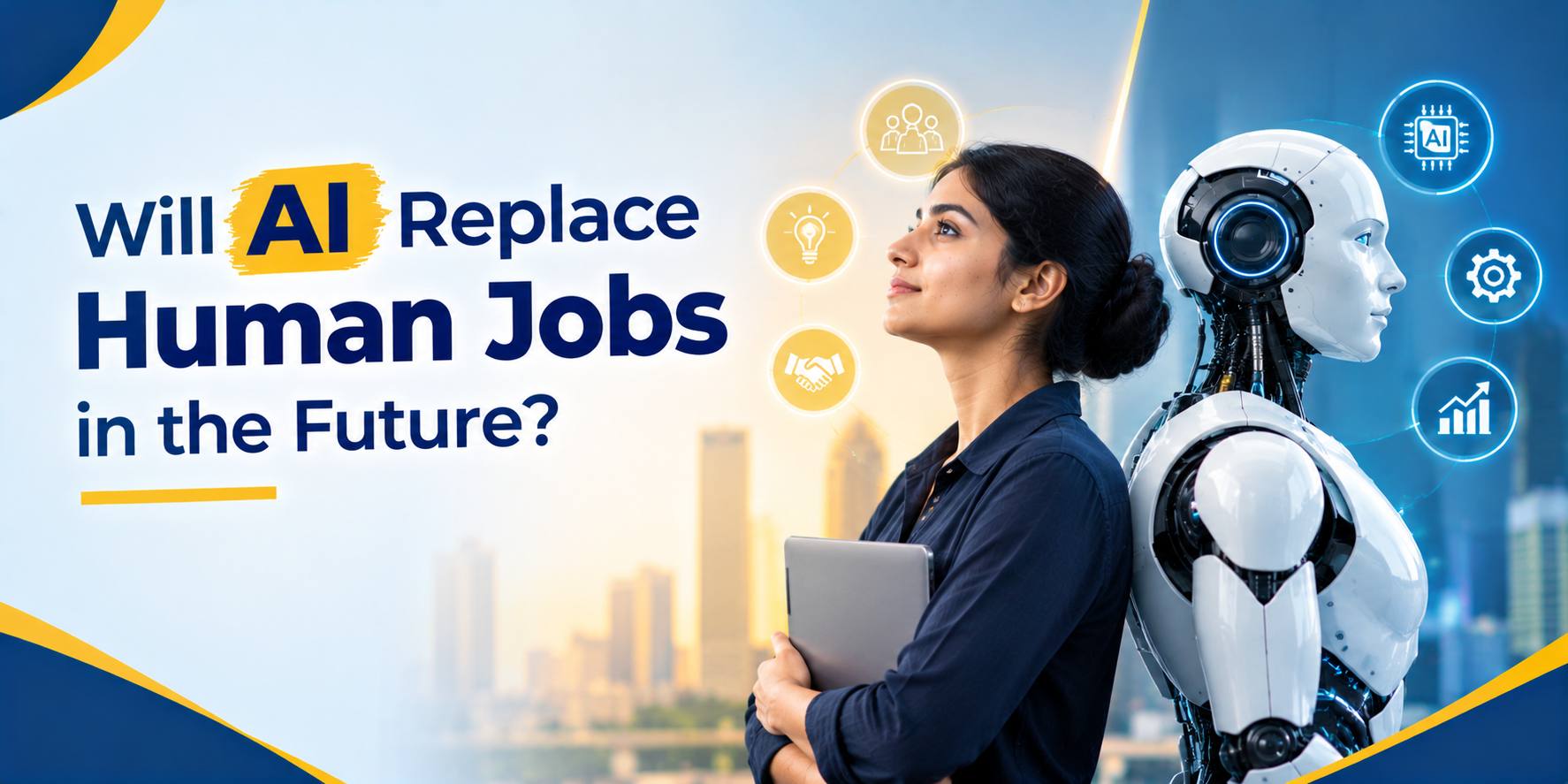
Artificial intelligence is changing the way people work. From writing emails and analysing data to answering customer questions and assisting with software development, AI tools are becoming part of everyday professional life. As these technologies improve, one question is becoming increasingly important for students, job seekers and working professionals: will AI replace human jobs in the future?
The answer is more complicated than a simple yes or no. AI can automate certain tasks, reduce the time needed to complete routine work and change the responsibilities associated with many occupations. Some jobs may experience a decline in demand for particular tasks, while others may evolve or create opportunities for people with new skills.
For students planning their careers in 2027, understanding these changes can help them make more informed decisions about education, training and professional development.
This guide explores jobs that may face greater automation pressure, careers that could benefit from AI adoption, and the skills worth developing to remain adaptable in a changing employment market.
Will AI Replace Human Jobs in the Future?
AI is likely to transform many workplaces, but that does not mean every occupation will disappear. The impact depends on the tasks involved, the capabilities of available technology, the cost of implementation, industry requirements and the need for human judgement.
For example, an AI tool can prepare a first draft of a report, but a professional may still need to verify the information, interpret the findings and explain their implications. Similarly, a chatbot can answer a common customer question, while a human representative may be needed to resolve a sensitive complaint.
Three broad changes are worth understanding:
-
Task automation: AI takes over repetitive activities within an existing job.
-
Job transformation: Employees use AI to complete work differently or more efficiently.
-
New job opportunities: Organisations need people to develop, operate, evaluate and manage AI-based systems.
The future will not look the same across all industries. The important question is not only whether AI can perform a task, but also whether it can do so reliably, safely and economically in a real workplace.
Jobs That May Be at Greater Risk Due to AI
Jobs involving repetitive digital work, standardised information processing and predictable workflows may experience greater automation pressure. However, the level of risk differs between employers and industries, and higher exposure does not automatically mean that an occupation will disappear.
1. Data Entry and Administrative Jobs
Data entry and routine administration involve many tasks that software can already assist with. AI-enabled systems can extract information from documents, update records and organise digital files.
Jobs and roles that may be affected include:
-
Data entry operator
-
Data processing clerk
-
Document processing assistant
-
Records management clerk
-
Database updating assistant
-
Form processing assistant
-
Typing and transcription operator
-
Routine reporting assistant
-
File management assistant
-
Administrative data coordinator
Employees who develop spreadsheet, database, workflow automation and data verification skills may be better prepared to take on more complex responsibilities.
2. Customer Service and Call Centre Jobs
AI chatbots and voice assistants can handle common questions, booking requests, order tracking and basic troubleshooting.
Roles that may experience automation pressure include:
-
First-level customer support executive
-
Call centre agent handling routine enquiries
-
Chat support executive
-
Email support representative
-
Appointment booking agent
-
Order status support executive
-
Basic technical support representative
-
Complaint classification assistant
-
FAQ support agent
-
Script-based telemarketing agent
Human support will remain important for complex complaints, sensitive conversations, unusual problems and situations requiring empathy or negotiation.
3. Basic Content Writing and Copywriting Jobs
Generative AI can produce first drafts of product descriptions, social media captions, simple articles and standard marketing messages.
Tasks and roles that may be affected include:
-
Basic SEO content writer
-
Product description writer
-
Routine blog draft writer
-
Simple social media caption writer
-
Email copywriting assistant
-
Basic advertising copywriter
-
Short product review writer
-
Newsletter content assistant
-
Simple website content writer
-
Standard marketing text creator
Writers can strengthen their career prospects by learning research, interviewing, fact-checking, content strategy, subject expertise and editorial judgement. Content that offers original insights and trustworthy information requires more than simply generating text.
4. Translation, Transcription and Subtitling Jobs
Speech recognition and machine translation can produce initial versions of transcripts, subtitles and translated documents.
Potentially affected roles include:
-
Basic transcriptionist
-
Audio-to-text transcriber
-
Routine subtitle creator
-
General document translator
-
Product localisation assistant
-
Meeting transcription assistant
-
Caption formatting operator
-
Standard multilingual content processor
Human expertise remains particularly important for legal, medical, technical and culturally sensitive material where accuracy and context matter.
5. Basic Graphic Design, Video and Audio Production
AI tools can generate images, adapt templates, remove backgrounds, create captions and assist with routine editing.
Potentially affected tasks include:
-
Template-based graphic design
-
Basic social media post design
-
Simple banner creation
-
Routine presentation layout
-
Basic photo background removal
-
Image resizing and formatting
-
Simple thumbnail design
-
Basic video clipping
-
Short-form video repurposing
-
Automatic captioning
-
Routine audio cleaning
-
Template-based animation
Designers and media professionals can build additional value through creative direction, original concepts, brand strategy, storytelling and an understanding of audience needs.
6. Routine Accounting and Bookkeeping Jobs
AI-enabled accounting software can categorise transactions, match invoices, identify inconsistencies and prepare routine financial reports.
Roles that may be affected include:
-
Basic bookkeeping clerk
-
Invoice processing assistant
-
Accounts payable processing clerk
-
Accounts receivable processing clerk
-
Expense claim processing assistant
-
Payroll data processing assistant
-
Routine bank reconciliation assistant
-
Basic financial data entry operator
-
Standard financial report preparation assistant
-
Billing and payment processing clerk
Accountants and finance professionals can strengthen their roles through financial analysis, compliance knowledge, audit skills, risk assessment and advisory work.
7. Banking, Insurance and Financial Processing Jobs
Financial institutions use automated systems to process documents, screen transactions and manage routine customer requests.
Potentially affected roles include:
-
Basic loan application processing clerk
-
Routine insurance claims processing assistant
-
Document verification assistant
-
Underwriting support assistant
-
Customer onboarding documentation clerk
-
Financial data processing operator
-
Basic transaction monitoring assistant
-
Insurance policy administration assistant
-
Standard financial services support representative
-
Routine payment processing clerk
Complex claims, unusual transactions, regulatory interpretation and decisions with significant financial consequences still require appropriate human oversight.
8. Sales, Marketing and Entry-Level SEO Tasks
AI can support customer segmentation, prospect research, campaign drafting, reporting and routine SEO activities.
Tasks and roles that may be affected include:
-
Telemarketing executive using fixed scripts
-
Basic lead qualification assistant
-
Routine email campaign operator
-
Basic keyword research assistant
-
Meta title and description writer
-
Routine SEO audit report compiler
-
Rank tracking report assistant
-
Competitor data collection assistant
-
Basic CRM data updating executive
-
Routine marketing report compiler
Digital marketing professionals can improve their long-term value by developing technical SEO, analytics, conversion optimisation, search intent analysis, campaign strategy and content quality assessment skills.
9. Research, Data Analysis and Reporting Jobs
AI can summarise documents, organise information, identify patterns and create initial data visualisations.
Potentially affected tasks include:
-
Basic online research assistant
-
Data collection executive
-
Survey data processing assistant
-
Routine spreadsheet reporting analyst
-
Basic market research data compiler
-
Standard report summarisation assistant
-
Basic data visualisation assistant
-
Routine information extraction assistant
-
Entry-level desk research assistant
The ability to check sources, validate data, identify bias and interpret findings will remain important for producing reliable research.
10. Legal, HR and Recruitment Support Jobs
AI can help search documents, screen information, draft standard descriptions and automate scheduling.
Potentially affected roles include:
-
Routine legal document formatting assistant
-
Basic legal research assistant
-
Contract data extraction assistant
-
Legal transcriptionist
-
CV screening assistant
-
Interview scheduling coordinator
-
Basic job description writer
-
Recruitment database updating assistant
-
Employee document processing clerk
-
Routine HR query support agent
Legal professionals and HR teams will still need to exercise judgement, protect confidential information, handle sensitive situations and ensure fair, responsible decisions.
11. Education and Training Support Tasks
AI can generate practice questions, summarise study material, prepare first drafts of learning resources and assist with routine assessments.
Potentially affected tasks include:
-
Basic worksheet creation
-
Routine quiz generation
-
Standard lesson material formatting
-
Automated scoring of suitable assessments
-
Basic educational content summarisation
-
Routine student query support
-
Training presentation creation
-
Transcript preparation
-
Learning resource categorisation
Teachers, trainers and mentors do more than deliver information. They help learners develop confidence, solve problems, understand difficult concepts and respond to individual learning needs.
12. Software Development and IT Support Tasks
AI coding tools can generate code, explain errors, create test cases and assist with technical documentation.
Tasks that may be affected include:
-
Basic code generation
-
Routine code conversion
-
Simple website template development
-
Basic software testing assistance
-
Routine test case generation
-
First-level IT help desk support
-
Basic bug report summarisation
-
Technical documentation drafting
-
Simple script maintenance
-
Standard software troubleshooting
Software professionals can build stronger foundations in programming, system design, cybersecurity, testing, requirements analysis and the evaluation of AI-generated code.
13. Cybersecurity and IT Operations Support
AI can help classify alerts, summarise logs and prepare incident reports.
Potentially affected routine tasks include:
-
Basic security alert triage
-
Log summarisation
-
Standard incident report preparation
-
Routine system monitoring
-
Vulnerability report compilation
-
Basic access request processing
-
IT asset record updating
-
Security documentation assistance
Cybersecurity still needs people who can investigate unfamiliar threats, design secure systems, respond to complex incidents and make risk-based decisions.
14. Retail, E-commerce and Customer Operations
Automated systems can organise product listings, process orders, answer routine questions and update inventory records.
Potentially affected roles include:
-
Basic product listing assistant
-
Product catalogue data entry operator
-
Routine inventory data updater
-
Order processing clerk
-
Standard return request processor
-
Basic product description writer
-
Pricing data compilation assistant
-
E-commerce customer query agent
-
Product categorisation assistant
-
Routine sales report compiler
Customer experience, complex returns, product advice and exception handling can still benefit from human involvement.
15. Travel, Tourism and Booking Support
AI assistants can suggest itineraries, answer common questions and process straightforward bookings.
Potentially affected roles include:
-
Routine travel booking assistant
-
Basic itinerary preparation assistant
-
Hotel reservation support agent
-
Ticket booking support executive
-
Routine travel enquiry agent
-
Itinerary change processing assistant
-
Travel information assistant
-
Reservation data entry operator
Human support remains valuable when travel arrangements change unexpectedly, emergencies occur or customers require personalised assistance.
16. Manufacturing, Warehousing and Logistics
Robotics, machine vision and automated planning systems can perform selected repetitive physical and administrative tasks.
Potentially affected tasks include:
-
Repetitive assembly line work in automatable settings
-
Routine visual inspection
-
Basic packaging line work
-
Standard product sorting
-
Repetitive material handling
-
Routine production data entry
-
Stock counting assistance
-
Standard parcel sorting in automated facilities
-
Dispatch documentation
-
Shipment tracking support
The actual impact depends on equipment, workplace conditions, investment costs and safety requirements. Maintenance, process improvement, safety supervision and complex hands-on work may continue to need skilled people.
17. Transport, Agriculture and Food Processing
AI-enabled machines may automate selected tasks in transport, farming and food production.
Examples include:
-
Routine route planning
-
Basic fleet monitoring
-
Transport documentation processing
-
Repetitive crop sorting
-
Produce grading in suitable facilities
-
Routine food packaging
-
Farm monitoring support
-
Repetitive processing line work
Adoption varies considerably by location, infrastructure, weather, regulation and the nature of the work. It would be misleading to assume that all driving, farming or food processing jobs will be replaced.
18. Healthcare Administration and Medical Documentation
AI can assist with medical transcription, appointment scheduling, billing records and document classification.
Potentially affected tasks include:
-
Medical transcription for routine dictation
-
Basic appointment scheduling
-
Medical billing data entry
-
Standard patient record updates
-
Insurance claim documentation
-
Medical report formatting
-
Routine healthcare enquiry support
-
Medical document classification
Healthcare requires privacy protection, clinical expertise, patient communication and careful oversight. Automating administrative work is not the same as replacing the responsibilities of doctors, nurses or other healthcare professionals.
19. Journalism, Real Estate and Procurement Support
AI can prepare structured summaries, draft listings and process routine supplier or property information.
Potentially affected roles and tasks include:
-
Basic news summary writer
-
Routine press release rewriting assistant
-
Standard media monitoring report compiler
-
Property listing description writer
-
Property database updater
-
Appointment scheduling assistant
-
Purchase order processing clerk
-
Supplier data entry assistant
-
Routine procurement report compiler
-
Standard shipment documentation clerk
Original reporting, source verification, negotiations, local knowledge and supplier relationship management require additional skills beyond producing standardised text or processing records.
20. Routine Office and Compliance Documentation
AI assistants can prepare meeting summaries, organise evidence and format documents.
Potentially affected tasks include:
-
Routine meeting minutes preparation
-
Basic presentation data updates
-
Spreadsheet formatting
-
Email drafting
-
Calendar coordination
-
Document summarisation
-
Standard compliance checklist processing
-
Audit evidence organisation
-
Quality report compilation
-
Routine document control
Employees who learn to supervise automated workflows, check accuracy and solve problems can move towards more complex responsibilities.
What Does This Mean for Students and Job Seekers?
The examples above are not a definitive list of occupations that will disappear. They highlight tasks that may be more exposed to automation. A job that includes routine tasks may also contain responsibilities that require creativity, practical judgement, collaboration or accountability.
Rather than avoiding an entire career because AI tools are improving, students should examine how their chosen field is changing and what additional skills will help them succeed.
Careers That May Create New Opportunities in the AI Era
AI adoption also creates demand for people who can build, operate, evaluate and apply these technologies. The availability of specific jobs will depend on industry growth, investment, location and employer requirements.
1. Artificial Intelligence and Machine Learning
AI and machine learning professionals develop systems that identify patterns, make predictions and assist with complex tasks.
Potential roles include:
-
AI engineer
-
Machine learning engineer
-
AI application developer
-
Natural language processing specialist
-
Computer vision engineer
-
AI research assistant
Students interested in these fields can begin with programming, mathematics, statistics and practical AI projects.
2. Data Science and Data Analytics
Organisations need people who can turn information into reliable insights and business decisions.
Potential roles include:
-
Data analyst
-
Data scientist
-
Business intelligence analyst
-
Data engineer
-
Analytics consultant
-
Data quality specialist
Useful foundations include statistics, spreadsheets, SQL, programming, visualisation and data interpretation.
3. Cybersecurity
The growing use of digital systems creates ongoing needs for protecting data, infrastructure and users.
Potential roles include:
-
Cybersecurity analyst
-
Security operations centre analyst
-
Penetration tester
-
Cloud security specialist
-
Security engineer
-
Digital forensics analyst
Training should cover networking, operating systems, security fundamentals and ethical practice.
4. Robotics and Automation
Industries using automated equipment need people to develop, operate and maintain systems.
Potential roles include:
-
Robotics engineer
-
Automation engineer
-
Control systems engineer
-
Robotics technician
-
Industrial automation specialist
-
Maintenance and reliability engineer
Electronics, mechanical engineering, programming and control systems can provide relevant foundations.
5. AI Governance, Risk and Responsible AI
AI systems can create challenges involving privacy, bias, transparency, safety and compliance. Organisations may need people who can evaluate these risks and establish responsible practices.
Potential roles include:
-
AI governance analyst
-
AI risk analyst
-
Responsible AI specialist
-
Technology compliance analyst
-
AI policy researcher
-
AI quality and evaluation specialist
These careers may draw on technology, law, public policy, risk management and domain expertise.
6. Healthcare and Life Sciences
AI can support medical research, healthcare administration, diagnostic workflows and pharmaceutical development. These applications still require domain knowledge and appropriate professional oversight.
Career pathways may include healthcare technology, biomedical research, medical laboratory science, bioinformatics, clinical data management and pharmaceutical quality functions.
7. Education and Learning Technology
AI can help personalise learning materials, support educational administration and create new digital learning experiences.
Potential roles include:
-
Educational technology specialist
-
Digital learning designer
-
Learning management system administrator
-
Instructional designer
-
AI-enabled training specialist
-
Educational content quality reviewer
Subject knowledge, communication, instructional design and technology skills can be useful in this area.
8. AI Implementation and Business Operations
Many organisations need employees who can identify suitable uses for AI, integrate tools into existing workflows and measure their effectiveness.
Potential roles include:
-
AI implementation specialist
-
Business process automation analyst
-
AI product manager
-
Technology consultant
-
Workflow automation specialist
-
AI solutions support specialist
These positions often benefit from a combination of technical knowledge, communication, project management and understanding of business operations.
Essential Skills to Learn for 2027
No single skill can guarantee job security. A combination of technical knowledge and human capabilities can help students and professionals adapt as workplace expectations change.
1. AI Literacy
Learn how AI tools work at a practical level, what they can do, where they make mistakes and when their output requires verification.
2. Data Literacy
Understand spreadsheets, basic statistics, data visualisation and how to interpret information. For more technical roles, consider learning SQL and a programming language such as Python.
3. Critical Thinking and Problem-Solving
AI-generated answers can be incomplete, outdated or incorrect. The ability to check evidence, question assumptions and make informed decisions remains valuable.
4. Communication and Collaboration
Clear writing, presentation, listening, teamwork and conflict resolution matter across industries. Technology does not remove the need to communicate effectively with people.
5. Creativity and Domain Expertise
A strong understanding of a subject helps professionals identify meaningful problems, evaluate AI output and apply knowledge to real situations.
6. Cybersecurity and Digital Responsibility
Learn basic data protection, password security, privacy practices and responsible technology use. Technical roles may require deeper security training.
7. Adaptability and Continuous Learning
Tools and workflows will continue to change. Building a habit of learning, practising and updating professional skills can help people respond to new expectations.
8. Practical Project Experience
Build small projects that demonstrate what you can do. Examples include a data dashboard, a simple website, an automated reporting workflow, a research project or an AI-assisted application with appropriate quality checks.
How Students Can Prepare for AI-Related Changes
Students do not need to choose an AI degree simply because AI is becoming more visible. The right course should match their interests, strengths and career goals.
Step 1: Choose a Field That Interests You
Consider engineering, computer science, healthcare, pharmacy, business, design, education or another field that suits your interests. Every industry is likely to keep evolving, but the pace and type of change will differ.
Step 2: Build Strong Subject Fundamentals
AI tools are more useful when you understand the subject in which you are applying them. Learn the concepts, practical methods and professional standards relevant to your chosen field.
Step 3: Learn Relevant Digital Tools
Start with tools that are genuinely useful for your studies or work. Depending on the field, these may include spreadsheets, programming environments, design software, analytics platforms or AI assistants.
Step 4: Practise With Real Projects
Apply your knowledge to practical problems. A portfolio of well-explained projects can demonstrate your ability to solve problems, verify results and learn independently.
Step 5: Develop Human Skills Alongside Technical Skills
Practise presentations, teamwork, writing, critical thinking and decision-making. These skills complement technical expertise and help you work effectively with colleagues and customers.
Step 6: Review Career Requirements Regularly
Look at current job descriptions, internship requirements and recognised training pathways. This will help you identify the skills employers actually request instead of relying on general predictions about the future.
How Working Professionals Can Adapt to AI
Professionals do not always need to change careers when AI tools enter their workplace. In many cases, the first step is learning how to use the technology responsibly within their existing role.
-
Identify repetitive tasks that could be automated.
-
Learn the AI and software tools relevant to your industry.
-
Verify AI-generated information before using it.
-
Improve skills in analysis, strategy and problem-solving.
-
Develop expertise that goes beyond routine task completion.
-
Keep learning about changes in your field.
-
Follow workplace policies on privacy, confidentiality and AI use.
For example, an SEO professional can use AI to organise keyword research or prepare a report draft while applying human judgement to search intent, technical issues, content quality and conversion strategy. Similarly, an accountant can use automated tools to process routine records while focusing on reconciliation, compliance and financial interpretation.
The goal is to combine professional expertise with technology rather than depend entirely on either one.
Will AI Replace Jobs in India in 2027?
The impact of AI in India will vary across sectors, employers and regions. Businesses may adopt AI to improve customer service, automate documentation, support software development, analyse information and manage digital operations.
For students and graduates, this means digital literacy and practical skills are becoming increasingly relevant across many career paths. However, it does not mean that every company will adopt AI at the same pace or that every occupation will experience the same level of disruption.
Job seekers should pay attention to actual hiring requirements, internship opportunities, recognised qualifications and the needs of their chosen industry. Students should also check current admission details and course information directly with official institutions before making education decisions.
Frequently Asked Questions
1. Will AI replace human jobs in the future?
AI is likely to automate some tasks, change job responsibilities and create demand for new skills. The extent of its impact will vary by occupation, industry, technology and workplace conditions. It is not accurate to assume that all human jobs will disappear.
2. Which jobs are most at risk due to AI?
Jobs involving repetitive digital tasks may face greater automation pressure. Examples include routine data entry, basic document processing, scripted customer support, standard content drafting and certain types of bookkeeping. Actual risk depends on the tasks and working environment.
3. Will AI replace software engineers?
AI coding tools can assist with code generation, debugging and testing. Software engineers are still needed to understand requirements, design systems, review code, address security issues and maintain reliable applications. The work may change as these tools improve.
4. Is content writing a risky career because of AI?
Routine content production may face more competition from AI-generated drafts. Writers can strengthen their position through research, original insights, subject expertise, interviewing, fact-checking, editorial judgement and content strategy.
5. Which careers may benefit from AI adoption?
Potential opportunities include AI engineering, data analytics, cybersecurity, robotics, automation, AI governance, healthcare technology and AI implementation. Demand will vary, so students should review current hiring trends and qualification requirements.
6. What skills should students learn for 2027?
Students can focus on AI literacy, data literacy, communication, critical thinking, problem-solving, digital tools and practical project experience. The most useful combination depends on their chosen course and career path.
7. Can AI replace teachers and healthcare professionals?
AI can assist with selected educational and healthcare tasks, but teaching and healthcare involve responsibilities such as human judgement, communication, care, safeguarding and professional accountability. The extent of automation will vary by task and setting.
8. Should students choose an AI-related course to secure their future?
An AI-related course may suit students interested in technology, programming, mathematics or data. However, no course can guarantee employment or immunity from automation. Students should consider their interests, academic strengths, course quality, practical training and career goals.
9. Will AI create new jobs as well as replace existing tasks?
AI can create demand for people who develop, integrate, evaluate, secure and manage AI systems. It may also change existing roles. The number and types of new jobs will depend on adoption, investment, regulation and broader economic conditions.
10. How can I make my career more resilient to AI?
Develop strong subject knowledge, learn relevant digital tools, practise problem-solving and communication, and gain practical experience. Keep reviewing how your industry is changing and learn to verify AI output rather than relying on it without checking.
Conclusion
The question “Will AI replace human jobs?” is best understood as a question about how work will change. AI can perform many repetitive and structured tasks, and some roles may see significant changes in responsibilities or demand. At the same time, organisations need people who can apply expertise, solve unfamiliar problems, manage relationships and take responsibility for decisions.
For students preparing for 2027, the most practical approach is to choose a field that matches their interests, build strong foundations and learn how technology is used in that profession. For working professionals, adapting to AI means identifying useful tools, checking their output and developing skills that extend beyond routine work.
AI may change how work gets done, but preparation matters. Build relevant skills, stay curious and learn to use technology responsibly so you can respond to opportunities and challenges as the employment landscape evolves.